Molecular and physical mechanisms of infection
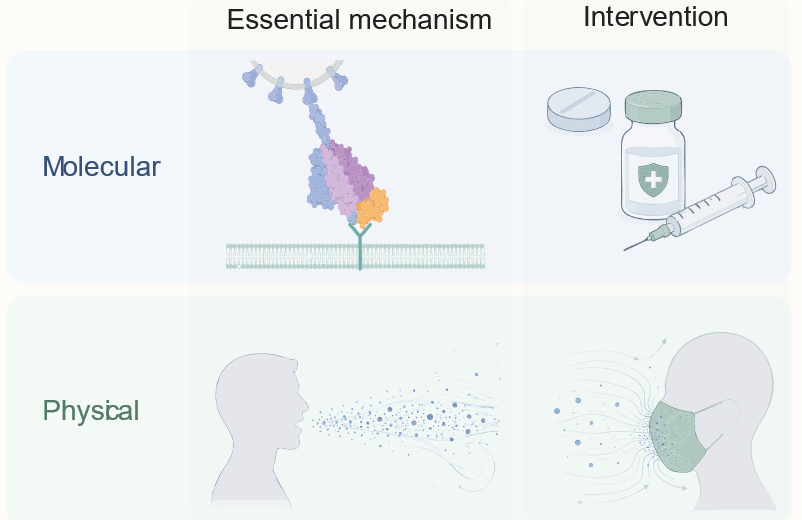
Most familiar tools against infectious disease rely on drugs and vaccines.
But infection is also a physical process. For example, the flu virus needs to ride exhaled water droplets to go from one person to the next. Tuberculosis bacteria must reach the lung and survive the forces inside it. Schistosome parasites must swim through water, find a human host, and burrow through skin. At each step, motion, flow, adhesion, and more generally physics decide whether the pathogen succeeds. And we can try to target these steps to prevent them from happening.
A very well example of a physics-based tool that target one of the physical steps a pathogen needs to go through is the mask. It acts as a barrier preventing airborne transmission of disease, and is an efficient complementary tool to fight these airborne diseases.
So we study the physical mechanisms of infectionwith the aim of finding overlooked physics-based bottlenecks, points where an infection could be disrupted by acting on how pathogens move and interact.
How we study the physics of infection
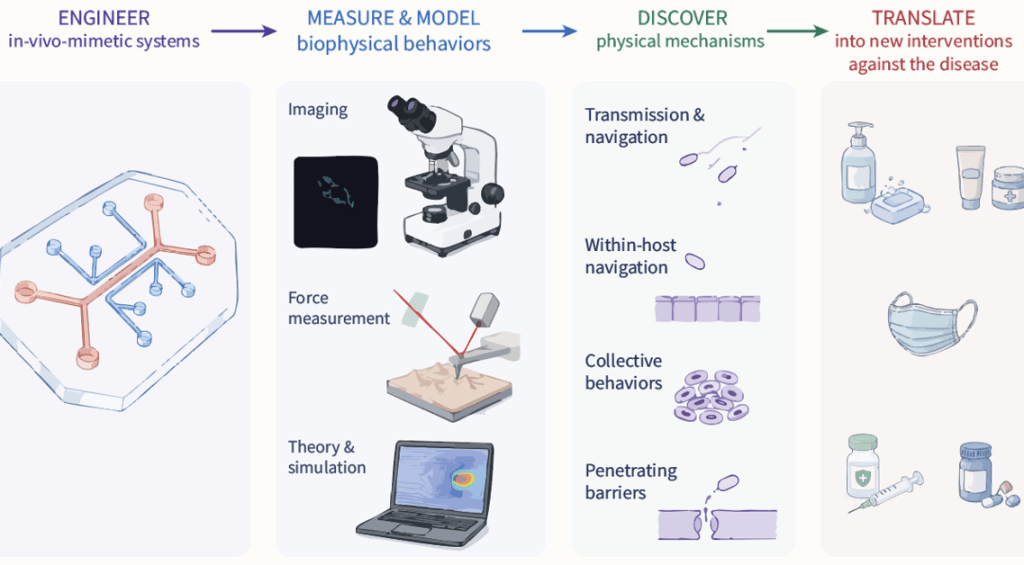
Our approach combines engineering, quantitative measurement, and biological questions.
We engineer in-vivo-mimetic systems, such as organs-on-a-chip, microfluidic devices, and tissue-like environments, that recreate selected features of infection in the lab. These systems let us isolate physical parameters that are difficult to control in a living host.
Within them, we measure and model biophysical behaviors using microscopy, force measurements, theory, and simulation, quantifying how pathogens move, adhere, organize, and interact with their surroundings.
From these experiments, we work to discover the physical mechanisms that shape infection: how pathogens navigate toward hosts, travel within the body, form collective structures, and cross physical barriers.
Our longer-term hope is to translate these insights into new interventions that complement existing drugs and vaccines by targeting the physical steps of disease.